

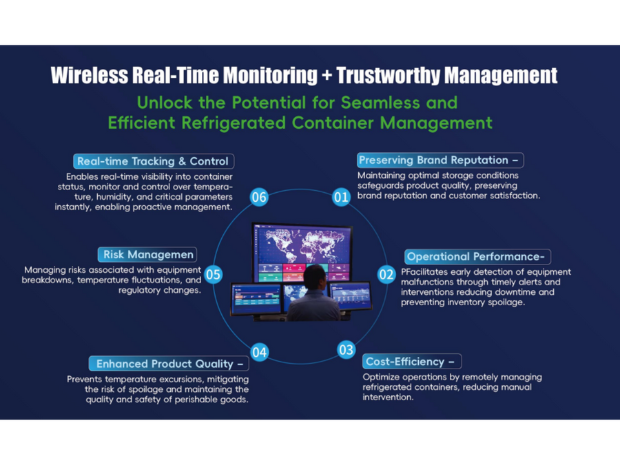

In today’s cold chain, silence is not golden—it’s dangerous. A container that isn’t reporting its temperature, humidity, and location might as well be sending a spoilage alert. For logistics managers handling pharmaceuticals, fresh produce, seafood, or dairy, waiting for a driver to notice a problem means waiting too long.
This forward-looking article discusses how real-time visibility solutions are revolutionizing cold chain management, covering temperature and location tracking, proactive alert systems, spoilage prevention case studies, and why remote monitoring for containers is becoming industry standard for pharma and perishable goods.
Background: The Old Way vs. The New Way
The Old Way (Reactive):
Load container → Dispatch → Hope for the best → Check temperature only at destination → Discover spoilage → File insurance claim → Lose customer trust.
The New Way (Proactive):
Load container → Activate wireless real-time monitoring system → Set custom alert thresholds → Receive instant SMS/email alerts if parameters drift → Intervene within hours (not days) → Deliver perfect cargo → Build customer trust.
The difference is not incremental—it’s transformational.
What Exactly Is Remote Monitoring for Containers?
Remote monitoring for containers is a hardware-plus-software solution that provides 24/7 visibility into your reefer container’s operational health from any internet-connected device.
Core Components:
Component
Function
IoT device/sensor
Attaches to or integrates with the reefer controller. Collects temperature, humidity, power status, and GPS location.
Cellular/satellite modem
Transmits data from the container (in transit, at port, or in depot) to the cloud.
Cloud platform
Hosts and secures data with 24/7 availability.
Dashboard (web/mobile)
Displays real-time readings, historical trends, and alarm status prominently.
Alert engine
Sends email, SMS, or app push notifications when parameters exceed custom thresholds.
Key Capabilities (from AML’s system):
- 24/7 cloud and on-premise infrastructure – Your data is always available, always secure.
- Critical alarm status prominent – Manage by exception. No need to stare at 100 normal readings; spot the one that needs action.
- Access anywhere in the world – Check temperature, control parameters, and sensor readings from your office, home, or hotel.
- Customizable data export – Download logs for analysis, customer reporting, or audit trails.
- Two-way communication – Upload software updates or download DCX data without visiting the container physically.
Why Remote Monitoring Is Becoming Industry Standard
Driver #1: Pharma Supply Chain Regulations
The pharmaceutical industry is the single biggest force driving remote monitoring adoption. Regulations like GDP (Good Distribution Practice) and WHO Annex 9 require documented temperature control throughout the supply chain.
Requirement: Continuous temperature monitoring with audit trails.
Solution: Remote monitoring logs every data point automatically. No manual paperwork, no gaps.
Driver #2: High-Value Perishables
A single 40ft reefer container of premium Japanese beef or Norwegian salmon can be worth
200,000–
200,000–500,000. Insurance covers product cost—it does not cover lost customer goodwill, rejected shipments, or destroyed brand reputation.
Requirement: Instant notification of any temperature deviation.
Solution: Real-time alerts let you intervene before cargo crosses the spoilage threshold.
Driver #3: Container & Equipment Utilization
Empty running, idle assets, and inefficient routing all destroy margins.
Requirement: Know where every container is and whether it’s loaded, empty, or under repair.
Solution: GPS location tracking integrated with temperature monitoring gives you fleet visibility traditionally reserved for mega-shippers.
Driver #4: Customer Expectations
Your clients—whether supermarkets, hospitals, or food distributors—increasingly demand proof of cold chain integrity. They want temperature logs, not promises.
Requirement: Shareable, timestamped, tamper-evident reports.
Solution: Export temperature and location data directly from your monitoring dashboard. Attach to delivery documentation. Build trust with transparency.
Case Study #1: Pharma Shipment Protection
Scenario: A logistics provider ships $2.5 million worth of insulin from Singapore to Jakarta. The shipment requires continuous 2°C–8°C temperature control. Any excursion above 10°C for more than 30 minutes voids the batch.
Without remote monitoring: The container’s data logger is downloaded only at destination. If an excursion occurred mid-transit, the shipper discovers it after delivery—too late to do anything except file a claim and lose the customer.
With remote monitoring: A truck’s reefer unit suffers a compressor fault 3 hours into the journey. Temperature rises to 9.5°C. An SMS alert is sent immediately. The logistics manager contacts the driver, arranges a emergency transshipment at a rest stop, and the cargo arrives at 7°C—fully compliant. Spoilage prevented: $2.5 million.
Case Study #2: Port Congestion Surprise
Scenario: A 40ft reefer of frozen seafood arrives at Singapore port for transshipment. Due to documentation delays, the container sits on a terminal reefer bank for 10 days instead of the planned 48 hours.
Without remote monitoring: The shipper assumes the container is plugged in and running. In reality, a faulty reefersocket caused intermittent power loss. By day 8, internal temperature reaches -5°C (target -18°C). By day 10, partial thawing has occurred. The seafood is rejected at destination.
With remote monitoring: The system detects power cycling and rising temperature on day 2. An alert is sent. The shipper contacts the terminal operator, who discovers the faulty socket and relocates the container. Temperature never exceeds -15°C. Cargo arrives intact.
Case Study #3: Empty Container Retrieval
Scenario: A construction company rents a refrigerated container for on-site cold storage during a 6-month project. After project completion, the container remains on site for another 3 months—because the rental company doesn’t know where it is.
Without remote monitoring: The container sits un-invoiced (or accruing late fees without the renter’s knowledge). The rental company loses revenue or damages customer relationships.
With remote monitoring: GPS tracking shows the container’s exact location. The rental company sends a retrieval team within days. Asset utilization improves by 15–20%.
Comparing Monitoring Methods: Which Is Right for You?
Method
Pros
Cons
Best For
Single-use data logger
Low upfront cost, disposable
No real-time alerts, no GPS, retrieve to download
Low-value domestic shipments
Bluetooth logger
No monthly fee, phone-readable
Requires on-site presence, short range
Warehouse-to-warehouse moves
Cellular remote monitoring
Real-time alerts, GPS, global coverage
Monthly subscription, requires cellular signal
High-value pharma/perishables, international logistics
Satellite monitoring
Works anywhere, no dead zones
Higher hardware cost, slower data rate
Ocean crossings, remote land transport
For most commercial logistics operations, cellular remote monitoring offers the best balance of cost, capability, and reliability.
How to Implement Remote Monitoring in Your Cold Chain
Step 1: Identify High-Risk Shipments
Not every container needs real-time monitoring. Prioritize:
- Pharmaceuticals and biologics
- High-value seafood, meat, or produce
- Long-duration shipments (over 3 days)
- Routes with known temperature or power risks
- New customers where trust is being established
Step 2: Choose Your Hardware
Select devices compatible with your reefer brands (Carrier, Thermo King, Daikin, Mitsubishi). Options include:
- External puck-style loggers – Attach magnetically to the container exterior. Easy to move between units.
- Integrated telematics – Hardwired into the reefer controller. More permanent but feature-rich.
- Probe-based systems – For hard-to-monitor cargo like bulk liquids or stacked pallets.
Step 3: Set Alert Thresholds
Default settings cause alert fatigue. Customize for each cargo type:
Cargo Type
Temperature Range
Alert Delay
Notification Recipients
Frozen seafood
-22°C to -18°C
15 minutes
Ops manager, driver
Chilled meat
-1°C to +4°C
5 minutes
Ops manager, quality team
Pharmaceuticals
+2°C to +8°C
1 minute
Ops manager, QA, customer
Fresh flowers
+2°C to +6°C
10 minutes
Ops manager
Step 4: Train Your Team
A monitoring system is only useful if people act on alerts.
- Dispatchers: Monitor dashboard during business hours.
- Managers: Receive after-hours SMS alerts for critical deviations.
- Drivers: Respond to in-cab alerts immediately.
- Customers: Receive optional read-only dashboard access for high-value shipments.
Step 5: Integrate With Existing Systems
Modern monitoring platforms offer APIs to export data to your:
- Transportation Management System (TMS)
- Warehouse Management System (WMS)
- Customer portal
- ERP (for billing and compliance documentation)
Common Objections (And Why They’re Outdated)
Objection #1: “It’s too expensive.”
Reality: A $50,000 cargo loss pays for 2–5 years of monitoring on your entire fleet. Most users see ROI on the first prevented spoilage event.
Objection #2: “Our drivers check temperatures manually.”
Reality: Drivers cannot check temperatures every hour on a 3-day journey. And they certainly cannot check at 3am while sleeping. Machines monitor continuously; humans intervene only when needed.
Objection #3: “We have insurance.”
Reality: Insurance replaces product value, not customer trust, rejected shipments, or destroyed relationships. And insurers increasingly require documented monitoring as a condition of coverage.
Objection #4: “We only do short hauls.”
Reality: Most spoilage happens in the first and last miles—precisely where power interruptions and door openings are most common. Short hauls need monitoring too.
The Future: Where Remote Monitoring Is Headed
Trend #1: AI-Powered Predictive Alerts
Instead of alerting after temperature exceeds a threshold, tomorrow’s systems will predict excursions before they happen—detecting a failing compressor hours before it fails, or noticing that a door has been left ajar for 15 minutes.
Trend #2: Blockchain-Integrated Logs
For pharma and high-value food, tamper-evident temperature logs on distributed ledgers will become standard for regulatory compliance and customer verification.
Trend #3: Solar-Powered & Low-Power Devices
New device classes will offer 6–12 months of battery life, making monitoring feasible for containers without external power (e.g., rail or barge transport).
Trend #4: Integration with Port & Terminal Systems
Real-time monitoring will eventually plug directly into port power management systems, automatically flagging faulty reefersockets and triggering work orders without human intervention.
Conclusion: Visibility Is No Longer Optional
The cold chain is becoming faster, more complex, and more valuable. Pharmaceuticals, fresh produce, and premium perishables now travel halfway around the world—and consumers expect them to arrive perfect. Remote monitoring for containers transforms cold chain logistics from reactive hope to proactive certainty. It gives you real-time temperature, humidity, and location visibility, instant alerts before spoilage occurs, and audit-ready documentation for customers and regulators.
Don’t wait for a spoiled shipment to discover the value of visibility.
Ready to take control of your cold chain? Contact AML Singapore to learn about our wireless real-time monitoring system and how it can protect your valuable cargo from pick-up to delivery.