

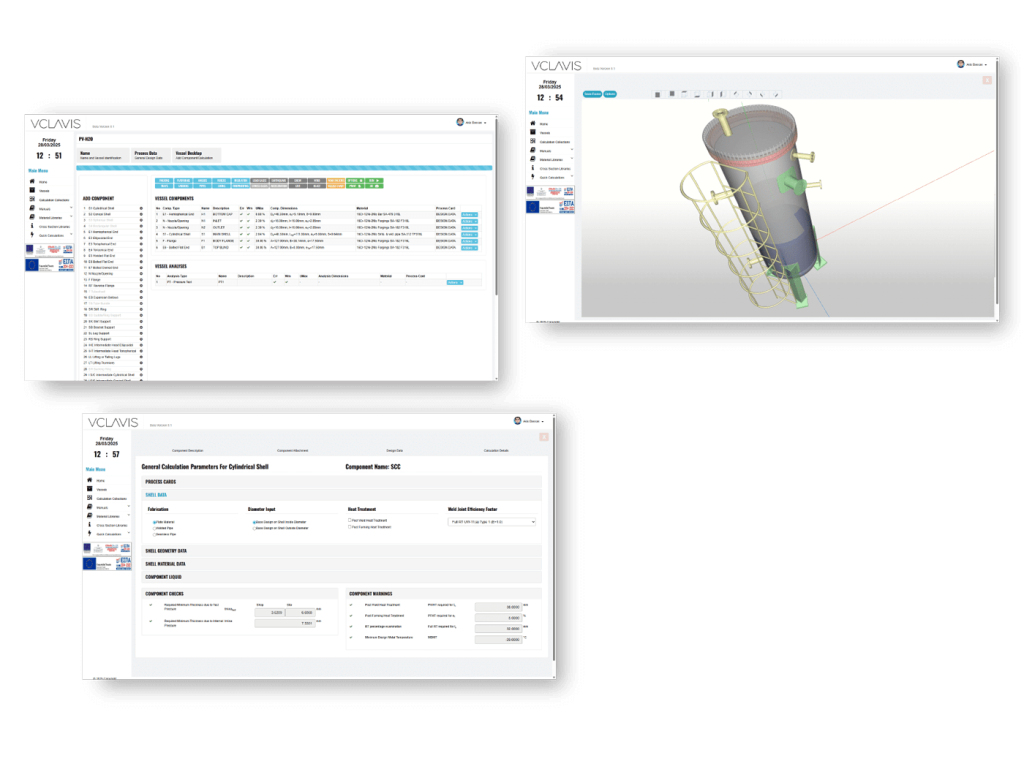

Dual chamber equipment introduces a level of complexity that goes far beyond standard vessel engineering. In many projects, the biggest challenge in pressure vessel and heat exchanger design begins with the preparation of the process data itself. Designers are required to manage two independent process cards that may contain different operating pressures, design temperatures, corrosion allowances, materials, and even entirely different process media. Collecting and validating these inputs is already demanding before any mechanical calculations begin.
The real difficulty appears during the detailed pressure vessel analysis phase. Each chamber may require its own Maximum Allowable Working Pressure (MAWP), separate hydrotest calculations, and independent design verification according to the applicable code rules. This creates a situation where the vessel cannot simply be treated as a single component. Instead, every chamber must be evaluated individually while still considering the interaction between both sections as one integrated assembly.
The physical arrangement of dual chamber systems also creates several structural complications. In some configurations, the chambers are separated by intermediate heads installed inside a common shell. These internal partitions require additional verification of the welded joints connecting the head to the shell, especially because the pressure differential between chambers can generate significant localized stresses. In other configurations, the system is effectively composed of two complete vessels connected through an intermediate pressure-less cylindrical section.
Stability is another major concern. For example for a dual chamber vessel, composing of two different pressure chambers connected via an intermediate shell, stresses are developed among the intermediate shell and the semispherical ends, just as when a skirt is connected on a head junction.
Fabrication and inspection add another layer of complexity. Different chamber materials may require separate welding procedures, distinct heat treatment requirements, or specialized non-destructive examination methods. Testing operations can also become complicated because one chamber may govern the hydrotest limitations while the adjacent chamber has completely different allowable conditions.
At present, very few software platforms can correctly address all these combined requirements in a unified environment. Among commercially available solutions, VCLAVIS is widely recognized as the only system capable of handling dual chamber calculations properly while accounting for the numerous interdependencies involved in these highly specialized vessels.