


The energy world is in a weird phase right now. Countries are searching for cleaner fuel systems, industries are feeling the heat to cut emissions, businesses are seeking out technologies that can realistically enable a low carbon future without grinding economies to a halt. During all this, electrolyzers quietly have become one of the most talked about pieces of the clean energy puzzle.
For most outside of the energy industry, the word “electrolyzer” probably hasn’t been used in everyday conversation, or they’ve never even seen one. But suddenly these systems are attracting billions of dollars in investment, major government attention and growing interest from industries that traditionally have relied heavily on fossil fuels. There is a simple reason. Electrolyzers are critical to producing green hydrogen, which many experts believe will be one of the fuels of the future.
The electrolyzer market is particularly interesting because it sits at the intersection of ambition and pragmatism. Governments are making bold climate commitments, but getting emissions down is proving extremely difficult in areas like heavy industry, shipping, aviation and chemical production. Renewable electricity won’t solve every problem. That’s where hydrogen comes in, and electrolyzers are the machines making much of that future a reality.
What Electrolyzers Actually Do
Basically an electrolyzer does this thing called electrolysis. It separates water into hydrogen and oxygen using electricity. The hydrogen can then be stored, transported or used as a fuel for different industrial and energy applications.
The concept is not new. Electrolysis is not a new technology. What’s changed is the urgency around clean energy and the availability of renewables like wind and solar. When renewable electricity is used to power electrolyzers, the hydrogen produced is often referred to as green hydrogen because the process avoids the bulk of carbon emissions.
That makes a difference. Most traditional hydrogen production relies on natural gas, which emits considerable greenhouse gases. Green hydrogen provides a cleaner option, especially for sectors that cannot be directly electrified. Today there are various electrolyzers on the market such as alkaline electrolyzers, proton exchange membrane systems and solid oxide electrolyzers. Each technology has advantages depending on efficiency, scalability, operating conditions and cost.
For the non-technical person, it might help to think of electrolyzers as energy conversion systems. They convert renewable electricity into a fuel, which can be transported and used at a later date. That flexibility is part of the excitement of the market.
Why the Electrolyzer Market Is Taking Off
The electrolyzer market’s growth is closely tied to the global decarbonization drive. Countries across Europe, Asia, North America and the Middle East are pouring funds into hydrogen strategies, seeing it as a long-term solution to decarbonising industry.
Of special importance here are heavy industries, such as steel making, refining and chemical production. These sectors consume large amounts of energy and often rely on high-heat processes that are hard to replace with batteries or direct electricity alone.
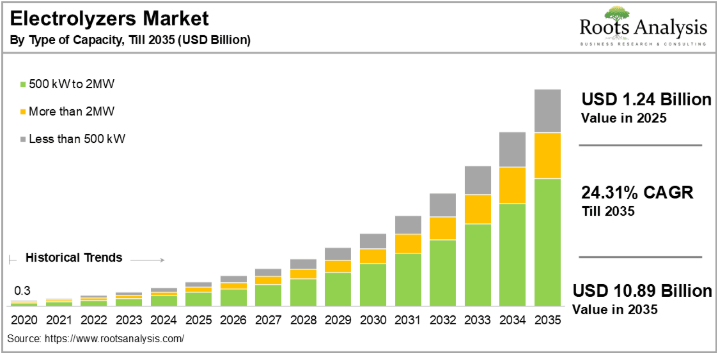
I just found Roots Analysis and they said, “As per the global electrolyzers market size forecast, the market is expected to grow from USD 1.24 billion in 2025 to USD 10.89 billion by 2035, at a CAGR of 24.31% during the forecast period 2025-2035.” That sort of projected growth shows just how seriously governments and industries are taking the development of hydrogen infrastructure.
Another driver of demand is energy security. Many countries are seeking to reduce dependence on imported fossil fuels and diversify their energy systems. Domestic green hydrogen produced with renewable energy offers a potential way to greater energy independence.
Market shaping is also driven by corporate sustainability goals. Investors, regulators and consumers are putting more pressure on big firms to cut emissions. Such projects involving hydrogen and supported by electrolyzers are part of those broader environmental strategies.
Electrolyzers And Renewable Energy Are Becoming Tightly Coupled
One of the most interesting features of the electrolyzer market is the growing integration of the industry with the development of renewable energy. On the flip side, wind and solar have one big problem. They don’t make electricity all the time. Sometimes renewables produce more than what is needed right now, especially when it is sunny or windy. “Instead of wasting that excess electricity, electrolyzers can use it to produce hydrogen for later use.”
This is a bit of an energy storage opportunity. In some cases, hydrogen can be stored for longer periods than battery systems, which can be useful for balancing energy supply and demand over time. Several countries are already investing in large scale hydrogen hubs where renewable energy and electrolyser infrastructure are working in concert. Combined offshore wind and hydrogen production projects are attracting major attention, especially in Europe.
There is also increasing interest in the use of green hydrogen for transport applications such as fuel cell trucks, trains and shipping. Battery electric systems are a hot topic in passenger vehicle discussions, but hydrogen could play a larger role in heavy transportation where range and fast refueling are more important. Electrolyzers, one energy consultant called them, “Bridges between renewable power and industrial reality,” and that seems a surprisingly apt way to describe their function.
Market Challenges Holding Back
But the electrolyzer market still has a few big hurdles to clear that may affect the speed of growth, despite the excitement. Cost is still one of the biggest worries, The cost of green hydrogen production via electrolyzers is higher than the cost of traditional methods of hydrogen production in many parts of the world. Economics are influenced by renewable electricity prices, equipment costs and infrastructure development.
Another issue is scaling production. Electrolyzer demand is surging, but large increases in manufacturing capacity will be required to meet future targets. Critical material and component supply chains are still evolving. Infrastructure limitations also pose problems. Hydrogen transport, storage and distribution infrastructure needs large investment. Developing a full hydrogen economy is a lot more than just installing electrolyzers.
Another neglected problem is the availability of water. Electrolysis depends on water resources and large scale hydrogen production could raise concerns in areas already suffering from water scarcity. There are efficiency debates in the energy industry as well. “Some critics argue that it is often more efficient to directly electrify rather than converting electricity to hydrogen and then back again to usable energy. Hydrogen supporters argue that some sectors just cannot operate solely on batteries or direct electrical systems.
The truth is probably somewhere in the middle. Clean energy solutions can vary for different industries based on their operational needs.
The Human and Economic Standpoints of the Market
One of the things that is lost in the technical discussions is the broader economic and social impact associated with the electrolyzer market. Hydrogen projects are creating new jobs in engineering, manufacturing, infrastructure development and renewable energy. Regions are competing to become a future hydrogen hub, as they see economic opportunity alongside climate goals.
Investment in hydrogen can bring significant benefits to communities that have abundant renewable energy resources. Ports, industrial zones and energy exporting countries are all watching how green hydrogen could transform local economies.
At the same time there is healthy caution with regard to hype. The clean energy industry has seen technologies become popular, only to hit delays, budget overruns or slower-than-expected adoption. But some analysts caution against viewing hydrogen as a magic bullet for all energy needs. But there is a change underway. Corporations that once viewed hydrogen as experimental are entering into long-term agreements, building pilot plants and putting serious money into electrolyzer projects.
Industries and governments are looking for real solutions to reduce emissions while ensuring reliable energy systems, and the electrolyzer market is growing as a result. Electrolyzers are a critical part of the production of green hydrogen, which is increasingly being recognized as an important part of the future energy mix.
Hydrogen’s uses keep growing – from industrial manufacturing and transportation to storage of renewable energy. Investment is surging as countries race to build cleaner and more resilient energy infrastructure. But there are still major challenges of cost, scalability, infrastructure and efficiency. But the momentum keeps building because many sectors see hydrogen as a key tool, rather than a replacement for all energy sources, to help make the transition to the world of the future.
What’s especially interesting about the electrolyzer market is that it is a microcosm of a broader truth about clean energy. It will probably be a combination of technologies working together that will lead to the transition, not a single breakthrough. Electrolyzers are becoming an ever more important part of that bigger story.