

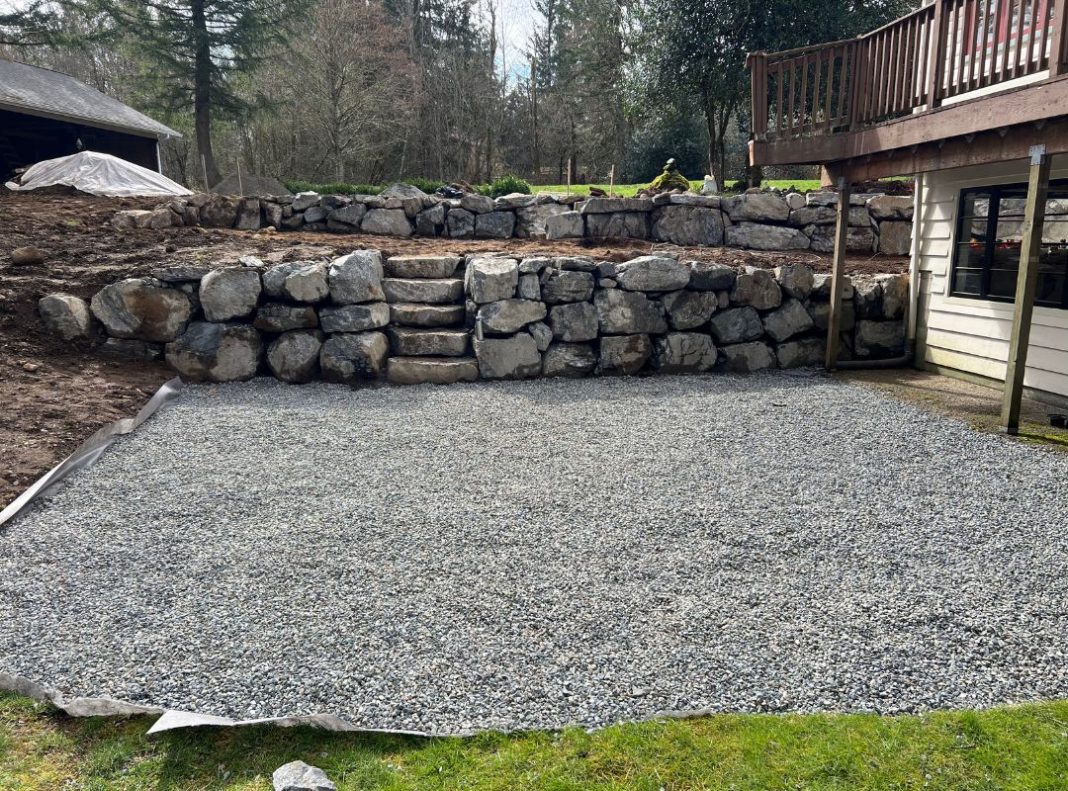

When people think about landscaping, they often picture greenery, patios, or decorative features. But in areas like Seattle and King County, the most important elements of a yard are often the ones you don’t immediately notice. Beneath the surface, structural solutions play a critical role in keeping outdoor spaces safe, stable, and usable. One of the most important of these solutions is the rock retaining wall.
The Problem With Uncontrolled Slopes
Hilly terrain is common across Western Washington. While it adds character and elevation to properties, it also introduces risk. Without proper support, soil on a slope naturally shifts downward over time. Rain accelerates this process by loosening the ground and increasing its weight.
This can lead to:
- Gradual erosion that eats away at your yard
- Sudden soil movement during heavy storms
- Damage to nearby structures or walkways
- Unsafe, slippery outdoor areas
In many cases, these issues develop slowly, making them easy to overlook until the damage becomes more serious.
Why Rock Is a Reliable Structural Material
Not all retaining walls are created equal, and material choice plays a major role in long-term performance. Natural rock stands out because it aligns well with the environmental conditions of the Pacific Northwest.
Unlike treated wood or lightweight materials, natural stone is not affected by constant moisture exposure. It doesn’t rot, warp, or weaken under prolonged wet conditions. This makes it especially suited for regions where rainfall is a regular part of the climate.
Additionally, the weight and density of natural rock provide inherent stability. Instead of relying solely on reinforcement systems, the mass of the stone itself helps resist soil pressure from behind the wall.
A Natural Fit for the Landscape
Beyond function, rock retaining walls contribute to the visual harmony of outdoor spaces. In a region known for its forests, mountains, and rugged terrain, natural stone blends more seamlessly than manufactured alternatives.
Each stone varies in shape, size, and texture, which creates a more organic look. Over time, these walls often become part of the landscape itself, complementing surrounding plants, trees, and terrain rather than standing out as a constructed feature.
The Importance of Proper Construction
Even though rock is a durable material, the performance of a retaining wall depends heavily on how it is built. Poor installation can lead to uneven settling, water buildup, or structural failure.
Several factors influence the effectiveness of a retaining wall:
- Base preparation: A stable foundation prevents shifting over time
- Stone placement: Proper stacking distributes weight evenly
- Drainage systems: These reduce pressure caused by trapped water
- Wall angle and design: Slight backward lean (batter) improves stability
Without these elements, even a wall made from strong materials may struggle to hold up under real-world conditions.
Water Management Is Non-Negotiable
One of the biggest threats to retaining walls is water pressure. When rainwater collects behind a wall, it creates force that pushes outward. Over time, this pressure can cause cracks, bulging, or collapse.
That’s why drainage is built into the structure itself. Systems are designed to move water away efficiently, often without being visible once the project is complete. When done correctly, the wall remains dry behind the scenes, even during heavy rainfall.
Expanding How Outdoor Space Is Used
Rock retaining walls don’t just prevent problems—they also create opportunities. By reshaping uneven terrain, they allow homeowners to make better use of their property.
Spaces that were once too steep or unstable can be converted into:
- Functional garden areas
- Outdoor seating zones
- Safe walking paths
- Multi-level landscapes with defined sections
This transformation is especially valuable in urban and suburban areas where maximizing usable space is important.
Adapting to Local Conditions
Every property is different, and in regions like King County, no two landscapes behave exactly the same. Soil composition, slope angle, and water flow patterns all influence how a retaining wall should be designed.
For example, clay-heavy soil tends to retain water, increasing pressure behind walls. Steeper slopes may require more reinforcement or specific design adjustments. Access to the site also affects how construction is carried out, particularly when heavy equipment cannot be used.
Understanding these variables is key to building a wall that performs reliably over time.
A Long-Term Investment in Stability
A properly built retaining wall is not a short-term upgrade—it’s a long-term solution. When designed with the environment in mind, it can last for decades with minimal maintenance.
Instead of repeatedly addressing issues like erosion or drainage problems, homeowners benefit from a stable, predictable outdoor environment. This reduces ongoing maintenance and helps preserve the overall condition of the property.
For those interested in how these structures are planned and constructed in real-world settings, exploring professionally designed Rock Retaining Walls provides a deeper understanding of how durability and landscape design come together.
Final Perspective
In regions where land and weather are constantly interacting, stability is not something that happens by chance. It is built into the landscape through careful planning and the right structural elements.
Rock retaining walls represent one of the most practical ways to manage terrain, control water, and improve usability—all while maintaining a natural aesthetic. Rather than being just another landscaping feature, they serve as a foundation for safer, more functional outdoor spaces.