

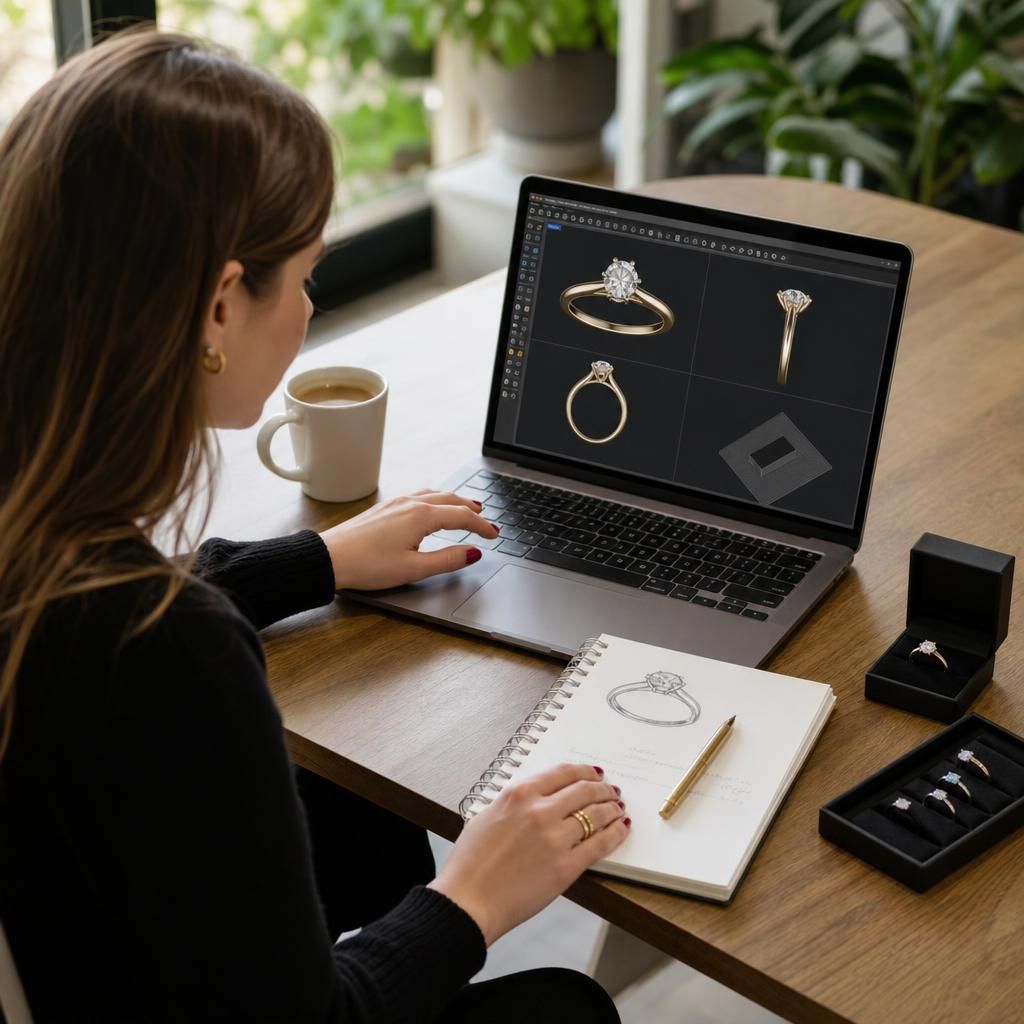

Buying an engagement ring has always involved a slightly unusual mix of emotion and practical decision-making. The piece may be symbolic, but choosing it still means thinking about budgets, stone shapes, settings, metals, proportions, and how the ring will stand up to everyday wear.
For years, that process largely happened across a jewellery counter. Today, more of the early decision-making takes place on a screen. Buyers can compare styles, explore different combinations and develop a much clearer idea of what they want before speaking to a jeweller.
That shift has not made engagement jewellery less personal. In many cases, it has done the opposite. Digital tools are giving buyers more opportunity to understand the choices behind a ring, while experienced jewellers still provide the knowledge needed to turn those preferences into a well-resolved piece.
The screen is becoming part of the consultation
Online ring design works best when it is treated as a starting point rather than a substitute for expertise. A buyer might know that they prefer an oval centre stone, for example, but may not immediately understand how its proportions will work with a particular setting or band width.
This is where specialist guidance becomes important. Steven Charles Quance approaches digital ring design as part of a broader jewellery-making process, allowing customers to explore options while still drawing on professional input. For people researching Engagement rings online, that combination of visual choice and specialist knowledge can make the process easier to understand.
The value of a design tool is not simply that it displays products. Its real usefulness lies in helping a buyer ask better questions. Once somebody can see how a round stone differs from an emerald cut, or how yellow gold changes the character of a setting, the conversation with a jeweller becomes more specific.
Instead of beginning with, “What should an engagement ring look like?”, the buyer can begin with, “This is the shape, metal and setting style that feels right. What needs refining?”
That is a much more productive place to start.
Personalisation is moving earlier in the buying journey
Traditional jewellery retail often asked customers to choose from finished rings and then make relatively small adjustments. Digital customisation has changed the order of that process. Buyers can now think about individual design elements before they commit to a finished piece.
That matters because an engagement ring is rarely judged in isolation. It has to suit the wearer’s taste, hand, lifestyle and, eventually, the wedding band that may sit beside it.
Steven Charles Quance works within the bespoke jewellery tradition, where those relationships between stone, setting, metal and proportion are central to the finished design. Digital tools can make that way of thinking more accessible because they allow customers to explore possibilities before final decisions are made.
There is also a practical advantage. Someone who has never bought fine jewellery may not know the terminology used to describe a setting or diamond shape. Seeing the options visually can bridge that knowledge gap without requiring the buyer to become a gemmologist overnight.
Good design technology therefore reduces uncertainty without pretending that every decision is simple.
More choice makes judgement more important
The internet has made it possible to compare an enormous number of engagement ring styles in a short period of time. That sounds entirely positive until the number of choices becomes difficult to manage.
A buyer can quickly move from considering a classic solitaire to looking at halo settings, trilogy rings, pavé shoulders, coloured gemstones, natural diamonds and lab-grown stones. Each new option creates another question.
This is one reason expertise still matters. Steven Charles Quance can help interpret preferences rather than merely present more of them. A skilled jeweller can look at what a customer likes, identify the recurring design features, and explain which choices are likely to work together.
The best online experience should support that judgement. It should not encourage people to add features simply because the software allows them to do so. Restraint is part of good jewellery design.
A ring with fewer elements can be more successful when its proportions are considered carefully. Equally, a more detailed design can work beautifully when the stone, setting and band are treated as a coherent whole.
The centre stone is only one part of the design
Engagement ring discussions often focus heavily on the diamond or gemstone. It is certainly important, but it is only one part of what the wearer sees every day.
The setting determines how the stone is presented and protected. The band influences comfort and visual balance. The metal affects colour, contrast and the overall feel of the design. Small changes in these areas can alter the character of a ring considerably.
Steven Charles Quance brings those considerations into the design process rather than treating the centre stone as the only meaningful decision. For buyers exploring Engagement rings online, it is useful to look beyond carat weight and consider how all the components will work together once the ring is on the hand.
This is also where online visualisation has its limits. A rendering can show style and proportion, but comfort, craftsmanship and the final finish still depend on how the ring is made. The digital stage can inform the decision. It cannot replace the craft behind the physical piece.
Lab-grown diamonds have widened the conversation
Another development changing engagement ring buying is the growing visibility of lab-grown diamonds. Their presence has given customers another route when deciding how to allocate a budget across stone size, setting and overall design.
Rather than assuming there is one correct choice, buyers can consider what matters most to them. Some may prioritise a particular stone size. Others may put more emphasis on the setting, metal or bespoke detailing.
Within the approach taken by Steven Charles Quance, the stone is considered as part of the wider ring design rather than as a decision that automatically dictates every other element. What matters is how the finished piece works as a whole.
A well-balanced ring is the result of several choices working together. Digital design can make those trade-offs easier to see before anything reaches the workbench.
Online research does not remove the need for trust
Fine jewellery is a category where confidence matters. Buyers are making decisions about an object intended to be worn for years, often without having much previous experience of stones, precious metals or jewellery construction.
An attractive website can provide inspiration, but it cannot by itself demonstrate judgement. Buyers still need clear information about what they are selecting and access to knowledgeable people when questions arise.
That is why the strongest digital jewellery experiences tend to connect technology with human expertise. Steven Charles Quance represents this hybrid approach, using online tools to make design choices easier to explore while retaining the specialist role of the jeweller.
For customers, that model can feel more natural than choosing between two extremes. They do not have to walk into a shop with no preparation, and they do not have to make every decision alone from a product grid.
A more informed kind of engagement ring shopping
The most interesting change in online jewellery is not simply that more rings can be bought through a website. It is that buyers can become involved in the design process earlier.
They can arrive at a consultation with references, preferences and a clearer sense of budget. They can understand the difference between several settings before committing to one. They can also see that an engagement ring is a collection of connected design decisions rather than a stone attached to a band.
For jewellers such as Steven Charles Quance, digital design creates an opportunity to make specialist knowledge easier to access. For buyers, it creates space to explore without rushing the decision.
The technology may be new compared with the traditions of fine jewellery, but the principle behind it is familiar. A successful engagement ring still depends on thoughtful design, appropriate materials, careful craftsmanship, and an understanding of the person who will wear it.