

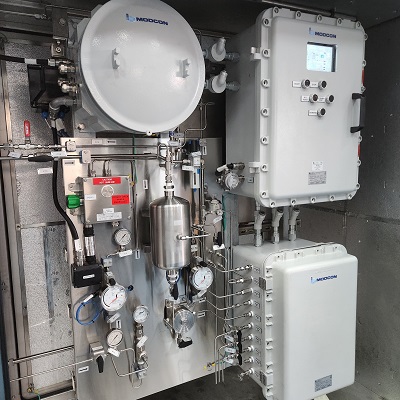

As industries move towards cleaner energy, digitalization, and higher operating efficiencies, one process variable is becoming increasingly important: oxygen concentration.
Whether in hydrogen production, natural gas processing, petrochemical plants, industrial gas manufacturing, or biogas upgrading, oxygen is far more than another analytical parameter. It is a critical indicator of process safety, equipment integrity, product quality, and operational efficiency.
Today, accurate industrial oxygen analyzers are helping operators reduce risk, improve reliability, and support more sustainable operations across a wide range of industries.
Why Oxygen Measurement Matters
Oxygen is highly reactive. While essential for many industrial processes, unwanted oxygen entering a system can quickly become a serious operational problem.
Even relatively small oxygen concentrations may result in:
- Increased fire and explosion risks
- Product contamination
- Corrosion of pipelines and process equipment
- Catalyst degradation
- Reduced process efficiency
- Higher maintenance costs
In hydrogen production, oxygen contamination can indicate gas crossover inside electrolyzers or storage systems. In natural gas processing, oxygen accelerates corrosion and contributes to the degradation of amine solvents used to remove hydrogen sulfide (H₂S) and carbon dioxide (CO₂). As the solvent degrades, operating costs increase while sweetening efficiency decreases.
In many industrial facilities, oxygen therefore becomes one of the earliest indicators that something within the process has changed.
The Challenges of Conventional Oxygen Measurement
Traditional oxygen analyzers typically rely on extractive sampling systems.
Gas is removed from the process and transported through filters, pressure regulators, dryers, pumps, and sample conditioning equipment before reaching the analyzer.
Although this approach has been widely used for decades, it introduces several limitations:
- Delayed measurements caused by sample transport
- Additional maintenance for sampling systems
- Risk of leaks and contamination
- Changes in sample composition before analysis
- Higher installation and operating costs
These challenges become even greater in high-pressure gas applications, where pressure reduction and sample conditioning add complexity while potentially affecting measurement accuracy.
Why Industry Is Moving Towards In-Situ Oxygen Measurement
To overcome these limitations, many operators are replacing extractive systems with in-situ oxygen analyzers.
Rather than transporting the gas to the instrument, an in-situ analyzer performs the measurement directly inside the process stream.
This provides several important advantages:
- Real-time oxygen monitoring
- Faster response to process changes
- No sample extraction or conditioning
- Lower maintenance requirements
- Improved measurement reliability
- Simpler installation
The result is a measurement that more accurately represents actual process conditions while reducing lifecycle costs.
Optical Technology Is Changing Industrial Gas Analysis
One of the most significant developments in recent years has been the adoption of optical oxygen analyzers.
These instruments use the principle of luminescence quenching. A specially engineered sensing material emits light when stimulated. Oxygen molecules reduce the intensity and lifetime of this luminescence in a predictable way, allowing oxygen concentration to be measured with high precision.
Unlike some traditional sensing technologies, optical measurement offers:
- Excellent long-term stability
- Minimal measurement drift
- Fast response
- Wide measurement range
- Low maintenance requirements
- High reliability for continuous operation
These characteristics make optical sensing particularly attractive for demanding industrial environments where equipment is expected to operate continuously with minimal intervention.
Supporting Both Safety and Sustainability
Industrial sustainability is often associated with renewable energy and lower carbon emissions. However, sustainable operation also depends on preventing waste, avoiding equipment failures, and improving process efficiency.
Accurate oxygen monitoring contributes by:
- Preventing hazardous operating conditions
- Extending equipment life
- Reducing chemical consumption
- Minimizing unplanned shutdowns
- Improving energy efficiency
- Supporting lower emissions through more stable operation
Simply put, safer processes are usually more sustainable processes.
A New Generation of Oxygen Analyzers
One example of this technological evolution is the MOD-1040 Oxygen Analyzer developed by Modcon Systems.
The analyzer performs direct in-situ optical oxygen measurement without sample extraction, pumps, filters, or sample conditioning systems. This provides immediate process visibility while reducing maintenance and improving measurement integrity.
Designed for demanding industrial applications, the MOD-1040 offers:
- Oxygen measurement from 1 ppm to 100%
- Operation at process pressures up to 350 barg
- Response time below 5 seconds in many applications
- Automatic pressure and temperature compensation
- ATEX and IECEx Zone 1 certification
- SIL 2 certification for safety-related applications
- Bluetooth-enabled commissioning and diagnostics
- Robust design for harsh industrial environments
These capabilities make it suitable for hydrogen production, natural gas processing, petrochemical plants, industrial gases, biogas facilities, and other applications where reliable oxygen monitoring is essential.
Looking Ahead
As hydrogen infrastructure expands and industrial facilities become increasingly digital, reliable process measurements are becoming more valuable than ever.
Artificial intelligence, predictive maintenance, advanced process control, and digital twins all depend on accurate, real-time information. Without reliable measurements, even the most advanced software cannot deliver reliable decisions.
Oxygen measurement is therefore evolving from a routine analytical task into a key component of industrial safety, operational excellence, and sustainable manufacturing.
The future of industry will not depend only on smarter software.
It will depend on smarter measurements.
And accurate, real-time oxygen monitoring is becoming one of the foundations of safer, cleaner, and more efficient industrial operations.