


For many pool owners, the dream of a crystal-clear oasis is often dampened by the reality of maintenance. While modern technology has gifted us with robotic pool cleaners that can roam the floor and suck up leaves, there remains a persistent “final frontier” in pool automation: the steps, benches, and tanning ledges (also known as Baja shelves).
If you’ve ever owned a standard pool robot, you’ve likely experienced the frustration of watching it wander aimlessly around the floor, only to “bonk” against the first step and turn away. This leaves you with the tedious task of manual brushing the very chore you bought a robot to avoid.
In this guide, we will explore why these elevated areas are so difficult to clean and what specific features you should look for to ensure your robot can handle every inch of your pool’s geometry.
The Engineering Challenge: Why Steps and Ledges Stymie Most Robots
To understand what makes a “best-in-class” cleaner, we first have to understand the physics of a swimming pool. Cleaning a flat floor is simple; cleaning a vertical transition is not.
1. The Buoyancy Problem
Most robotic cleaners rely on a balance of weight and drive-motor traction. As a robot climbs a wall or reaches a shallow tanning ledge, the change in water pressure and the proximity to the surface can cause it to lose “grip.” If a robot isn’t engineered with enough downward force, it will simply float off the step and tumble back to the floor.
2. The “Air Intake” Risk
Tanning ledges are often only a few inches deep. When a traditional robot attempts to climb onto a ledge, its intake valves may breach the surface of the water. If the pump sucks in air, it can cause the motor to stall or trigger a safety shut-off. A smart cleaner needs sensors to recognize these shallow zones.
3. Navigation Complexity
Traditional pool cleaners use “random path” logic. They move in a straight line until they hit an obstacle, then turn. This is highly inefficient for steps. Without sophisticated mapping or edge-detection sensors, a robot has a statistically low chance of actually landing on each step of a staircase.
Essential Features for Multi-Level Cleaning
When shopping for a cleaner that can actually handle steps and ledges, ignore the flashy colors and focus on these four technical pillars:
I. High-Flow Suction (GPH)
Suction isn’t just for picking up dirt; it’s for “sticking” the robot to the wall. Measured in Gallons Per Hour (GPH), a high suction rate creates a vacuum effect under the robot’s chassis. For pools with steep steps or high waterlines, you should look for a professional-grade motor ideally something in the 6,000 GPH range. This force ensures that even when the robot is vertical, it remains anchored to the surface.
II. AI-Driven Edge Detection
Modern high-end robots have moved beyond mechanical bumpers. The next generation uses infrared sensors and dual-sensor arrays to “see” the edge of a step or the perimeter of a tanning ledge. This allows the robot to follow the line of the step precisely rather than just bumping into it and turning away.
III. Intelligent Traction Systems
Standard plastic wheels often slip on smooth tile or vinyl steps. Look for robots equipped with high-traction tracks or specialized magnetic/rubberized wheels. These provide the friction necessary to make 90-degree transitions from floor to wall without losing momentum.
IV. Cordless Freedom and App Integration
Cables are the enemy of complex pool shapes. A corded robot can easily get its “tail” caught around a handrail or a corner step, limiting its reach. A cordless, battery-powered unit removes this physical constraint. Furthermore, app integration allows you to “spot clean” manually driving the robot via your smartphone to a specific ledge that needs extra attention.
Product Spotlight: The MOVA Diver A10
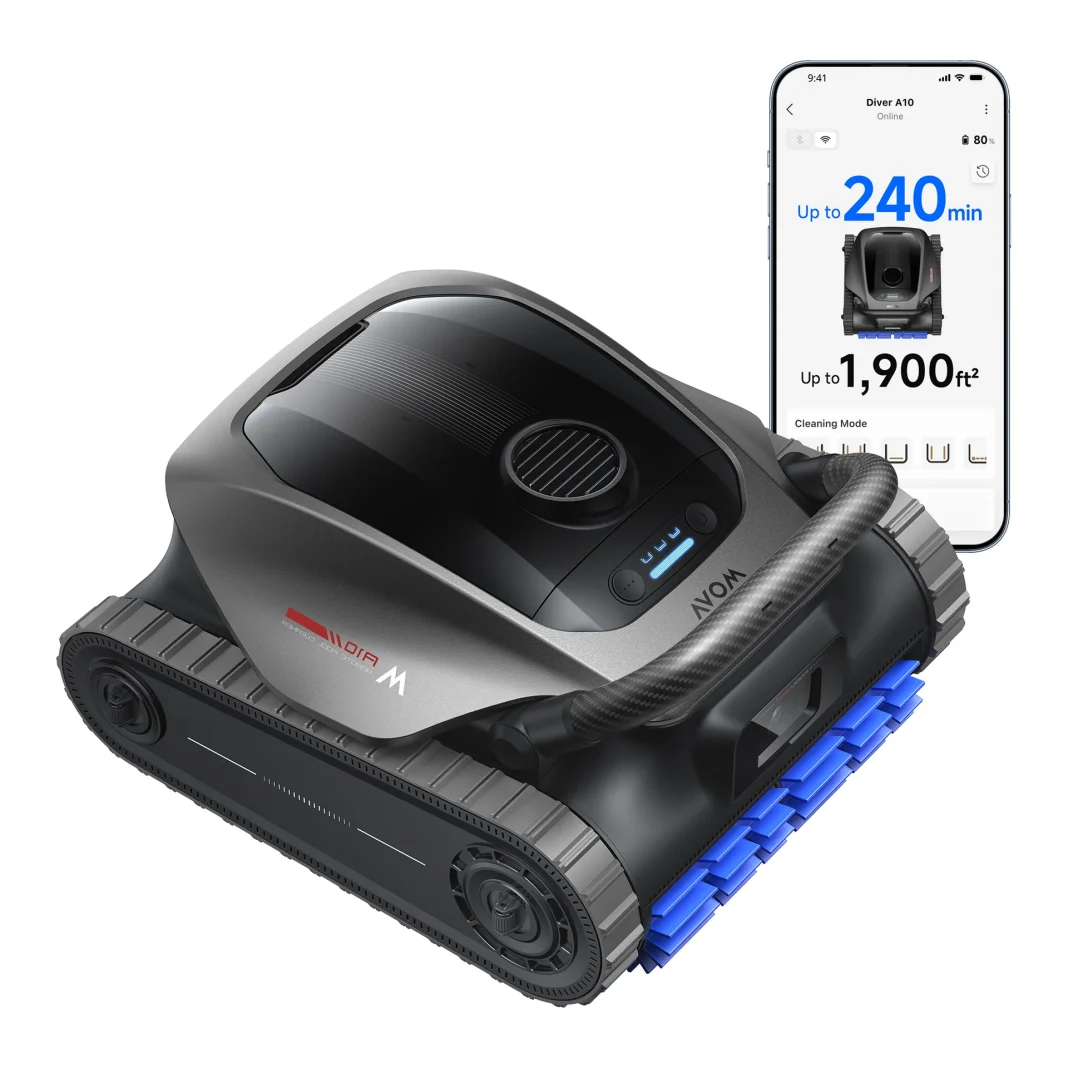
While many cleaners claim to handle the whole pool, the MOVA Diver A10 Robotic Pool Cleaner is specifically designed with the technical specs required for multi-level surfaces. Instead of a “one-size-fits-all” approach, it utilizes a suite of proprietary technologies to solve the step-and-ledge dilemma.
1. AI-Driven EdgePulse™ Navigation
The standout feature for step-cleaning is the EdgePulse™ technology. Using dual sensors and precision-engineered magnetic wheels, the Diver A10 performs “flawless edge tracking.” It doesn’t just hit the wall; it follows the perimeter, ensuring that the intersection where the floor meets the step a notorious hiding spot for algae is thoroughly scrubbed.
2. 6,000 GPH Extreme Suction
Powered by triple brushless motors, the Diver A10 offers 6,000 GPH of suction. This is professional-grade force. This massive suction allows the unit to maintain a death-grip on the pool walls and steps, eliminating the “float-off” problem common in cheaper models. Whether it’s sand on the floor or stubborn algae on a vertical riser, the force is consistent and powerful.
3. 240-Minute Extended Runtime
Cleaning complex geometry takes time. Steps and ledges require more maneuvering than flat floors. With a 169Wh high-capacity battery, the Diver A10 offers up to 4 hours of runtime. This is critical because it gives the AI enough time to navigate the deep end, the shallow end, and every stair in between on a single charge.
4. Dual-Pass Waterline Scrubbing
Most grime accumulates at the waterline, especially on tanning ledges where the sun accelerates algae growth. The Diver A10 is designed to climb 2″ above the waterline, providing a deep-scrubbing action that erases oil lines and stubborn grime.
5. Smart App Control
Through the MOVAhome App, users can choose from 8 different cleaning modes. If your tanning ledge is particularly dirty after a weekend of use, you can customize the cleaning path or utilize smart parking to ensure the robot is easy to retrieve from the shallow area.
Maintenance Tips to Help Your Robot Succeed
Even the best robot needs a little help from the owner. To ensure your steps and ledges stay pristine, follow these best practices:
- Brush the “Dead Zones” Occasionally: Even with AI, some internal corners of steps are physically too small for any robot to enter. A quick 30-second brush of these tight corners once a week will push debris into the robot’s path.
- Keep Your Water Chemistry Balanced: Slippery walls are usually the result of a microscopic biofilm or algae. If your pH or Chlorine levels are off, even the best traction wheels will struggle to climb.
- Empty the Filter Basket Early: A full debris basket reduces suction power. For a robot like the Diver A10, which has a massive 3.5L ultra-fine filtration system, this is less of an issue, but it’s still good practice to rinse the filters after every long cycle to maintain that 6,000 GPH force.
- Utilize “Floor-Only” or “Wall-Only” Modes: If you know the floor is clean but the ledges are dusty, use your app to set the robot to a specialized mode. This focuses the battery life on the areas that need it most.
Conclusion
The “perfect” pool clean is no longer defined by how clear the deep end looks; it’s defined by the lack of debris on your steps and the absence of an oil ring on your tanning ledge. When selecting a robotic cleaner, move past the basic marketing and look at the GPH suction, the navigation sensors, and the climbing ability.
The MOVA Diver A10 represents a significant leap in this category, combining AI-driven precision with raw mechanical power. By investing in a robot that understands the “edges” of your pool, you aren’t just buying a cleaner you’re buying back your Saturday mornings.
Stop brushing and start swimming. Your pool’s steps deserve a professional touch.