

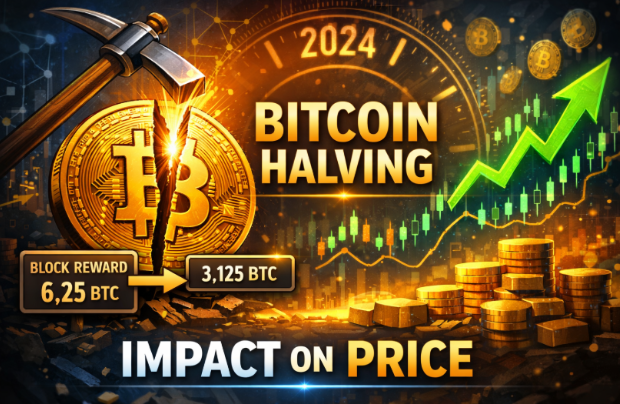

Bitcoin halving is a core mechanism that controls supply and influences long-term price trends. Every four years, the Bitcoin network reduces miner rewards by 50%, making new Bitcoin more scarce.
This event has historically been linked to major price movements and market cycles. Understanding Bitcoin halving is essential for anyone analyzing long-term crypto trends or making investment decisions.
If you are looking for a deeper outlook on future price movements, you can also explore this detailed guide on Bitcoin price prediction by Cryptowealthnet.
What Is Bitcoin Halving?
Bitcoin halving is a built-in process in the Bitcoin protocol where mining rewards are cut in half approximately every 210,000 blocks (around four years).
This mechanism ensures that Bitcoin’s total supply remains capped at 21 million coins and reduces inflation over time.
Bitcoin Halving Timeline
| Year | Block Reward |
| 2009 | 50 BTC |
| 2012 | 25 BTC |
| 2016 | 12.5 BTC |
| 2020 | 6.25 BTC |
| 2024 | 3.125 BTC |
Why Bitcoin Halving Matters
Bitcoin halving plays a crucial role in maintaining scarcity.
When the supply of new Bitcoin decreases while demand remains constant or increases, it creates upward pressure on price.
This is why Bitcoin is often referred to as digital gold and considered a hedge against inflation.
Key Concepts
- Reduced supply issuance
- Fixed maximum supply (21 million BTC)
- Long-term deflationary model
Bitcoin Halving Impact on Price
1. Supply Shock Effect
After halving, fewer Bitcoins are mined daily. This reduces selling pressure from miners and creates a supply-demand imbalance.
Result: potential price appreciation over time
2. Historical Price Performance
Bitcoin’s past halvings have been followed by strong bull markets:
- 2012 → Major rally to $1,000+
- 2016 → Bull run to $19,700
- 2020 → All-time high near $69,000
Pattern observed:
Bitcoin price tends to rise within 12–18 months after halving.
3. Market Cycle Influence
Bitcoin operates in cycles:
- Accumulation phase
- Halving event
- Bull market expansion
- Bear market correction
4. Institutional and Retail Demand
Halving events often attract:
- Institutional capital inflows
- Increased retail participation
- Media attention
This amplifies price momentum and volatility.
The 2024 Bitcoin Halving Explained
The most recent halving took place in April 2024, reducing the block reward to 3.125 BTC.
Key Effects
- Lower Bitcoin inflation rate
- Increased scarcity
- Strengthened long-term bullish narrative
Unlike previous cycles, Bitcoin showed strong price action even before the halving, indicating evolving market dynamics.
Does Bitcoin Always Increase After Halving?
No. While historical data shows strong post-halving growth, price movements depend on multiple factors:
- Global liquidity
- Interest rates
- Institutional adoption
- Regulatory environment
Future Outlook: What to Expect After Halving
Based on historical patterns, Bitcoin may enter a growth phase after the halving cycle.
However, each cycle evolves due to:
- ETF adoption
- Institutional participation
- Global economic conditions
Conclusion
Bitcoin halving is a fundamental mechanism that reduces supply and shapes long-term price trends. It has historically been associated with major bull runs, but it is not the sole driver of price.
Understanding halving cycles helps investors analyze market structure and make informed decisions.
For more in-depth crypto analysis and educational content, check out: Cryptowealthnet.
FAQs
What is Bitcoin halving in simple terms?
Bitcoin halving is an event where mining rewards are reduced by 50%, decreasing the rate at which new Bitcoin is created.
How often does Bitcoin halving occur?
Bitcoin halving happens approximately every four years or every 210,000 blocks.
Does Bitcoin price always go up after halving?
Historically, Bitcoin price has increased after halvings, but it is influenced by multiple market factors.
When is the next Bitcoin halving?
The next Bitcoin halving is expected around 2028.